
Assisi's Libraries, Part 3
Come with me to the Biblioteca Sacro Convento

After navigating the various libraries in this ancient pilgrim town, I finally landed at the Biblioteca Sacro Convento, a hidden library in the bowels of the great basilica of San Francesco. If not daily, in any case frequently, I ambled down my street to enter the ironed-gated area at the basilica that opened into a tranquil courtyard which, behind a few more doors, opened to the library space that would become my second home.
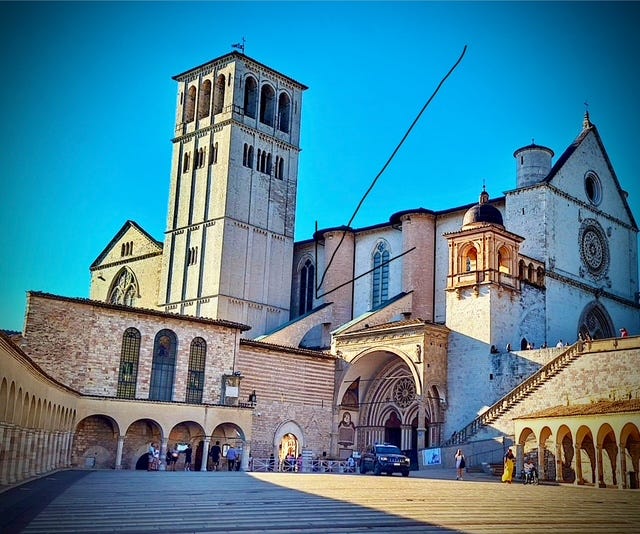
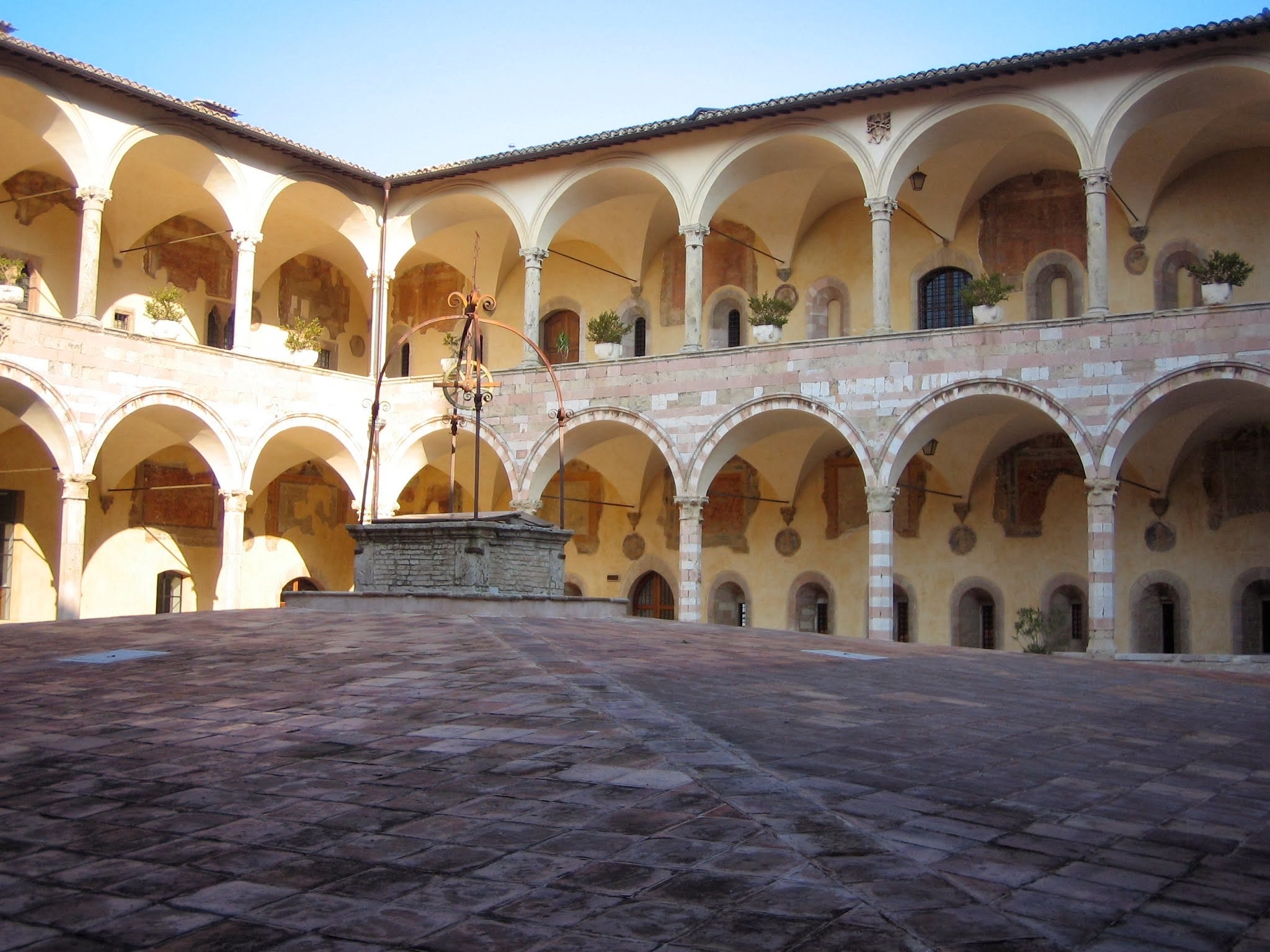
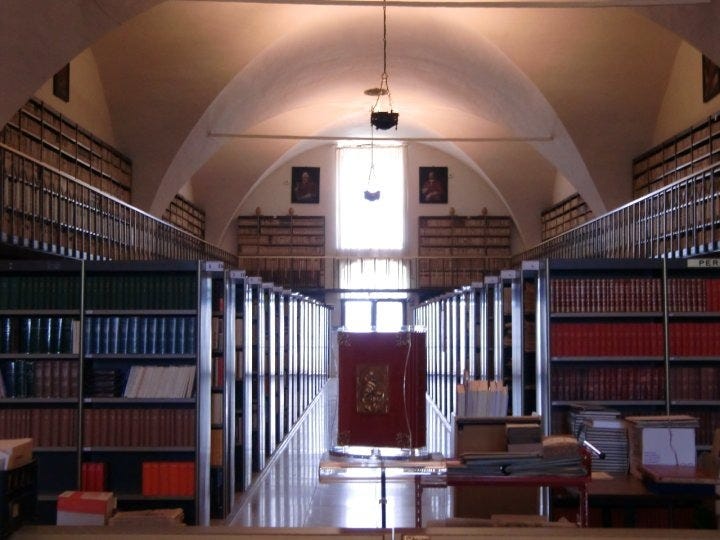
I felt it a privilege to sit in the sacred space where Francis’ closest companion, Brother Leo, had left so many manuscripts for us to ponder. There I was, an lone American woman living in an Italian town, going where Leo had gone to write about Francis; and now, I, myself was writing about Francis drawing upon the texts that Leo had crafted.
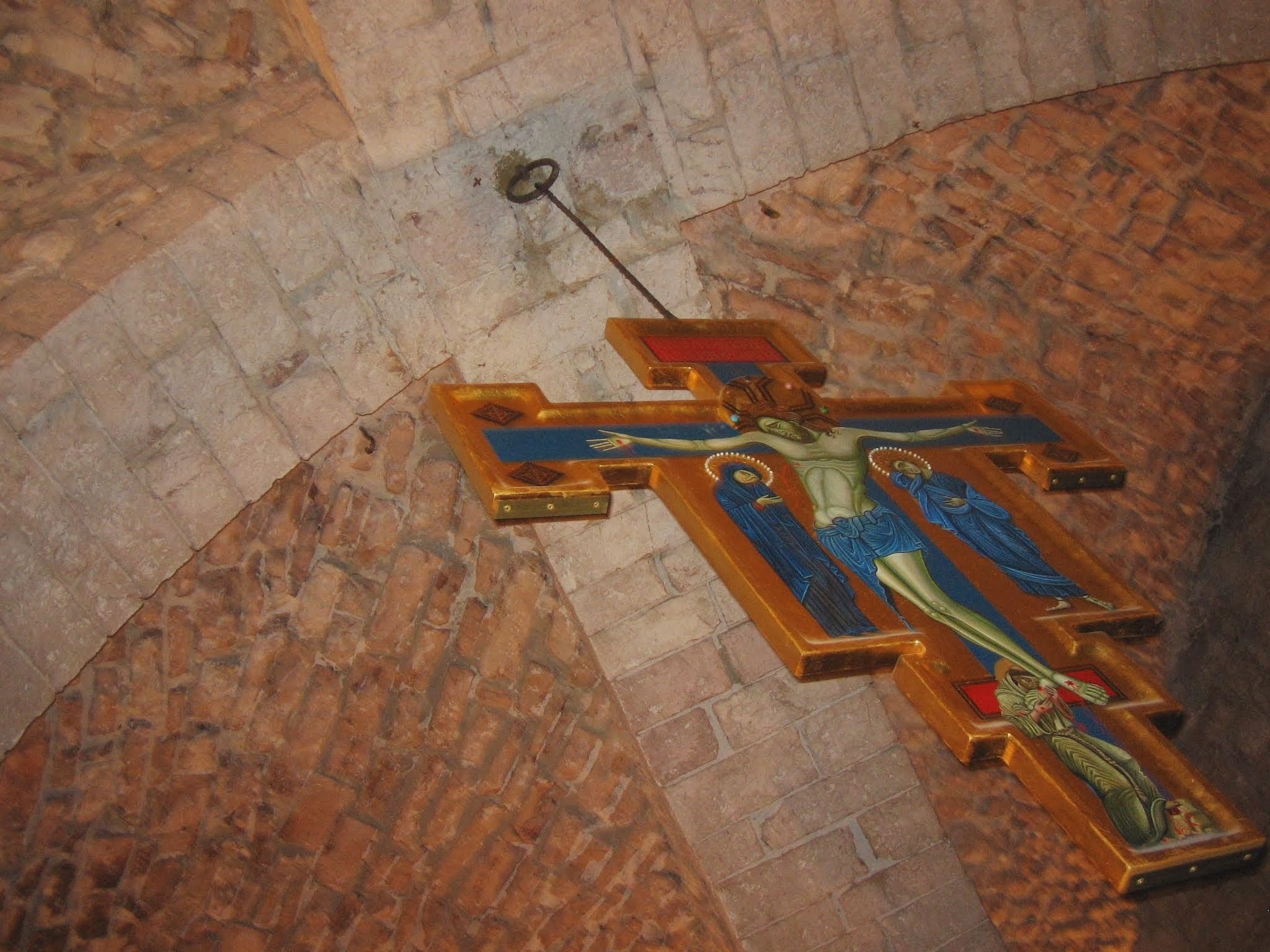
The Biblioteca del Sacro Convento remains one of the most significant repositories of medieval manuscripts, and especially those tied to Franciscan history and theology. The library’s Fondo Antico (ancient collection) includes approximately 709 manuscripts, many from the 13th and 14th centuries, including some of the earliest witnesses to Franciscan texts. The oldest manuscript is a Breviary dated 1227, which was used specifically to make copies. I saw them with my own eyes.
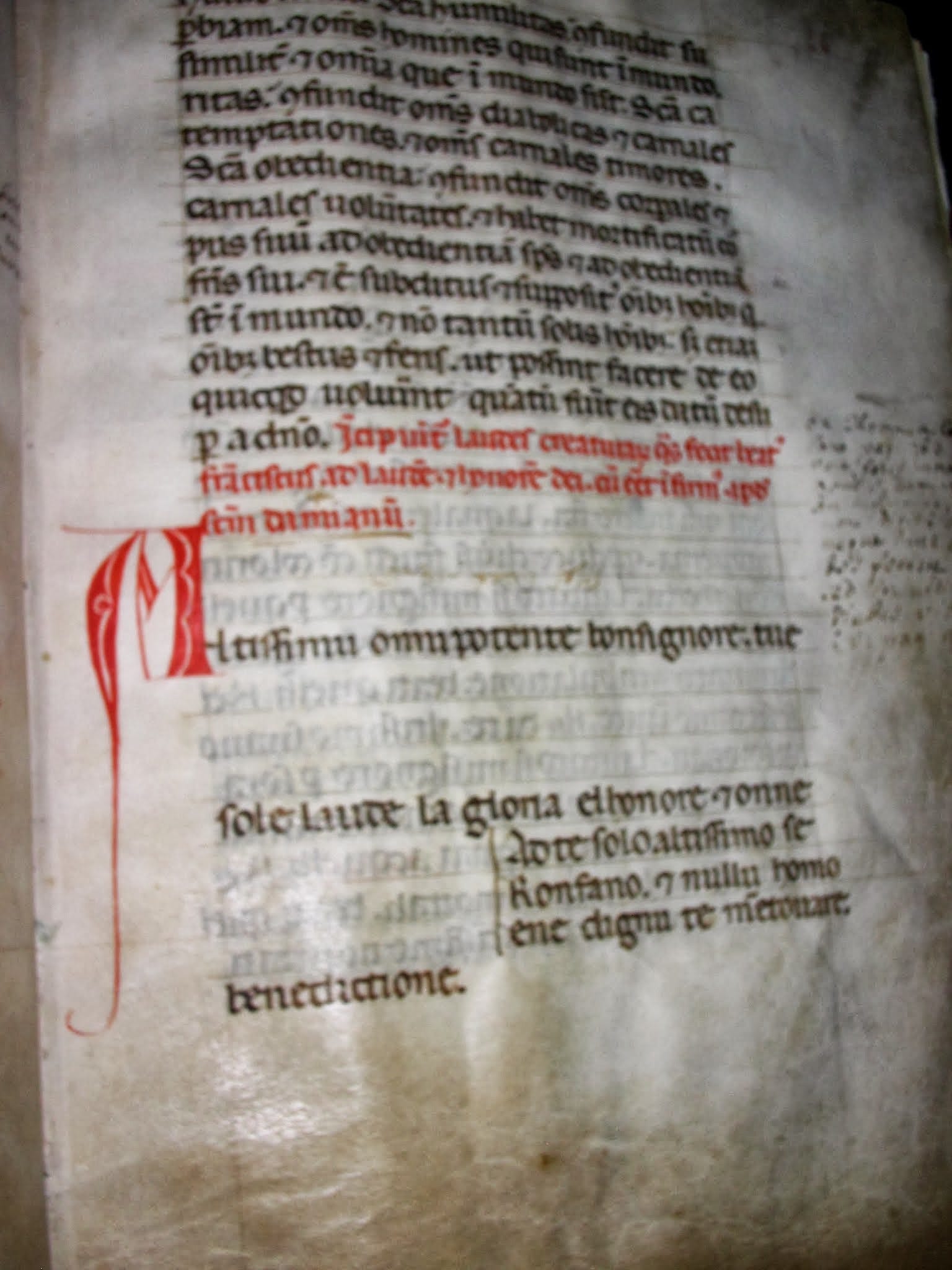
This where is housed the oldest known corpus of St. Francis’s writings, penned by his personal scribe, Brother Leo. It includes a copy of the Canticle of the Creatures, which Francis wrote near the end of his life during a time of excruciating physical pain and abandonment by those running his own Order. He was recuperating at the convent of San Damiano, where Clare’s contingent of women followers abided. Clare, being Francis’ soul companion, tended to her suffering beloved friend during this time of physical and spiritual desolation. Despite his trials, the peace and consolation he received while under her care opened up the mental and emotional space for Francis to compose this poetic text, which was the first of its kind in the Italian vernacular. (Less than a century later, Dante would follow suit, writing his Divine Comedy in vernacular Italian.) Leo depicted the opening line of Francis’ Canticle in black ink, except for the first letter, an ‘A’, which is written in bright red. The ‘A’ stands for Altissimo, the Canticle’s opening assertion: “Altissimo, onnipotente monsignore” (”Most high, all-powerful Lord”). Leo was a mindful arbiter of the written legacy of Francis and he understood the nuance behind highlight the opening assertion in this way, with the exaggerated letter “A,” even as Francis would have wanted this lyrical verse so emphasized.
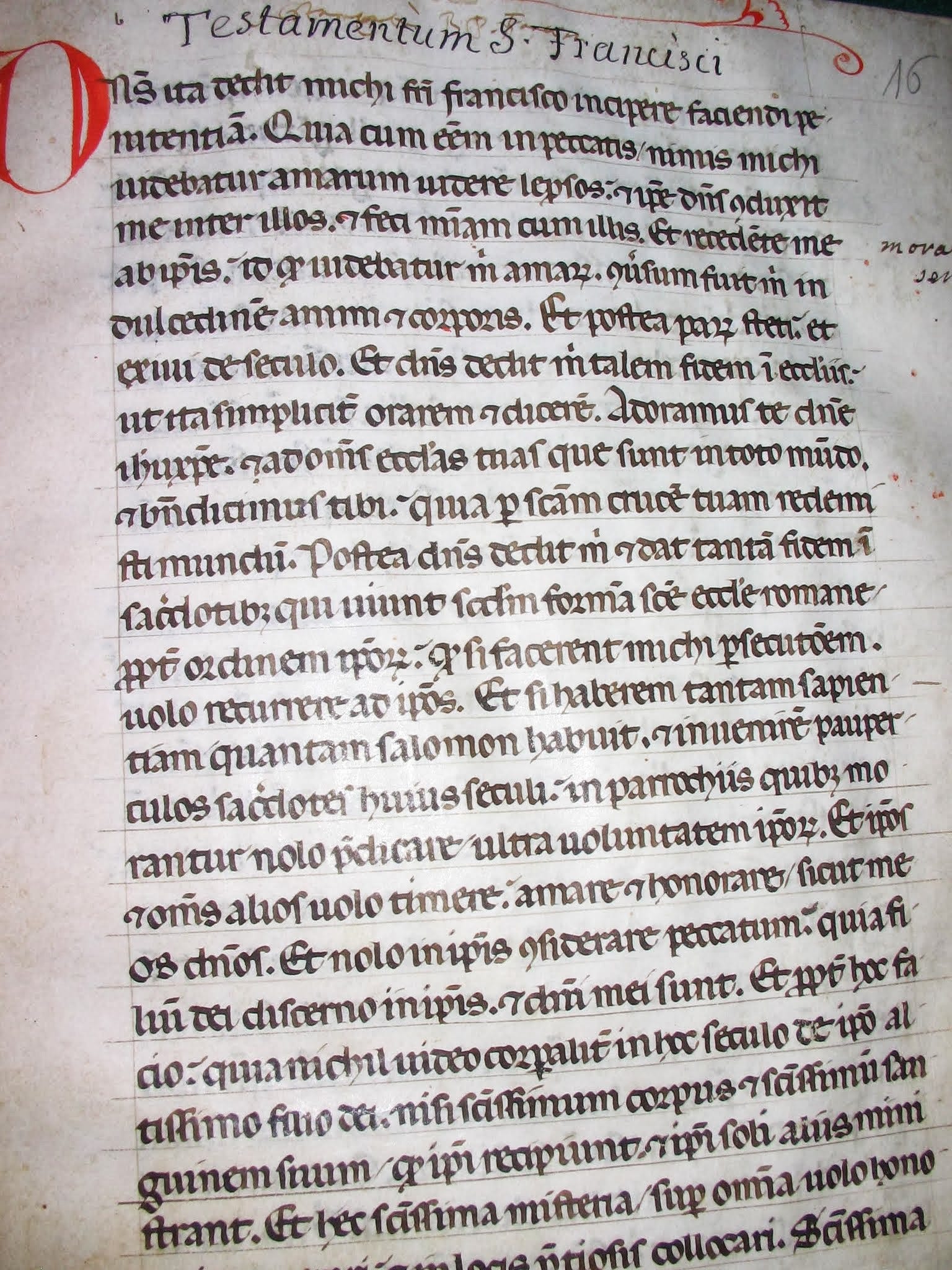
Leo also copied Francis’ Testament, which is a seminal document in Franciscan history, being Francis’ personal testimony, highlighting his conversion story and his intended desire for the future of his Order as recounted near the end of his life.
The library houses the earliest and most complete copy of Thomas of Celano’s Vita Secunda (Second Life of St. Francis), also known as the Memoriale in Desiderio Animae (Manuscript 686). This text is a critical biographical source for St. Francis, to expand on his life and miracles.
It likewise contains Bonaventure’s Legenda Maior and Legenda Minor, written in the 1260, which became the “official” biography of Francis and shaped the hagiography that became the official Franciscan narrative.
The oldest and most authoritative copy of the Liber of Blessed Angela of Foligno (Manuscript 342, late 13th century), a mystical text detailing her spiritual experiences. Angela’s work is a key source for medieval female mysticism, and this manuscript highlights the library’s broader role in preserving Umbrian spiritual traditions.
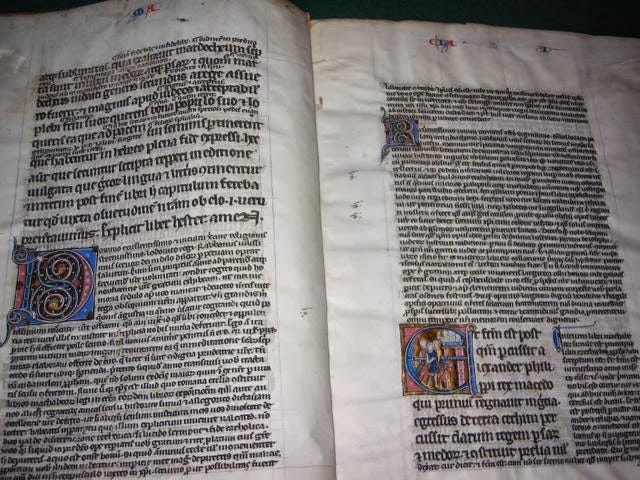
The manuscripts, primarily from the 13th century, are parchment codices, often written in Latin, with some in early Italian vernacular. Many bear the littera assisiensis script and include illuminations (around 70 manuscripts are illuminated), showcasing the artistry of the period. They cover liturgical, hagiographic, theological, philosophical, historical, and scientific topics, reflecting the multifaceted interests of the Franciscan community.
Evolution
The library began forming in the 13th century, shortly after Francis’s death in 1226, as the Sacro Convento was established around his tomb. Under the leadership of figures like Brother Elias, the Basilica and its community became a global pilgrimage center and the administrative heart of the Franciscan Order. A scriptorium was active by the mid-13th century, producing manuscripts for liturgical use and study.
Expansion and Scholasticism
The library houses other 13th and 14thcentury manuscripts, owing significantly through donations, notably from Cardinal Matteo d’Acquasparta (d. 1302), a former Franciscan Minister General and theologian, who bequeathed half his extensive collection to Assisi. The Fondo Antico expanded to include around 709 manuscripts, with roughly 4,000 printed books from the 15th and 16th centuries added later. The scriptorium continued producing codices, and the library served friars, scholars, and pilgrims.
The advent of printing in the 15th century shifted focus from manuscript production to collecting incunabula (early printed books) of which the library acquired thousands.
The library faced challenges during the Napoleonic era and Italian unification, with some manuscripts dispersed or at risk. In 1981, the Fondo Antico was formally placed under the Centro di Documentazione Francescana at the Sacro Convento, ensuring better preservation. Cataloging efforts, notably by Cesare Cenci (Bibliotheca manuscripta ad Sacrum conventum Assisiensem, 1981), documented the collection comprehensively. The 20th century saw renewed scholarly interest, with manuscripts like 338 gaining global attention.
Since the early 2000s, the library has embraced digital preservation through the Mediatheca Franciscana project, spearheaded by the Società Internazionale di Studi Francescani. Approximately 260,000 digital images of the Fondo Antico manuscripts are now available online, making texts like the Canticle of the Creatures accessible worldwide. Funded by the Italian Ministry of Cultural Heritage, the Fondazione Cassa di Risparmio di Perugia, and others, this initiative has modernized the library’s reach while protecting fragile originals.
Today, the Biblioteca Sacro Convento serves multiple roles, balancing its historical legacy with contemporary needs. We who have benefitted from this legacy owe a debt of gratitude to Pope Gregory IX who was the first of many subsequent popes to see the value in keeping Saint Francis firmly in the hearts of the people by erecting this edifice to his memory (despite what would have been Francis’ own opposition to it.
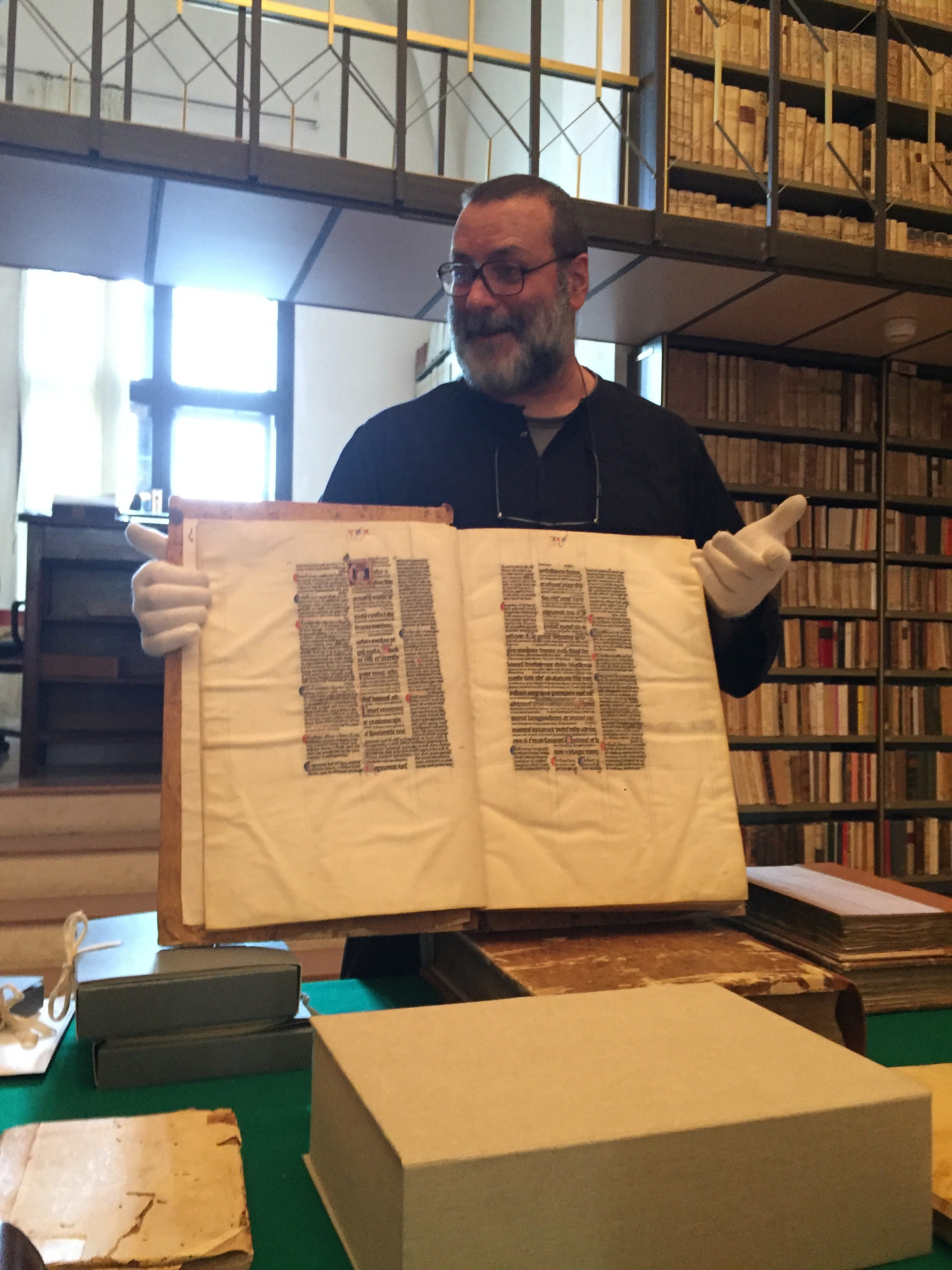
G. K. Chesterton said of his biography of Francis that it was “certain of failure.” But he was “not altogether overcome by fear” because Francis, he said, “suffered fools gladly.” We who write of St. Francis are the company of fools. We sequester ourselves in lonely libraries before unyielding sources and wish courage for ourselves. We tread where angels fear to. Yet, don’t you see, being the fool is the only way to find Francis? That is because he went where fools go. And those who seek for him, go to the library.
Wow, so beautiful. Love the photos: to think that Brother Leo inscribed that red A on that piece of parchment!
Did you ever read Kazantzakis’s book on Francis? He makes Leo a major character, if I remember well….